

New Report: Reduce vehicle fuel demand by 85% by curbing size, accelerating electrification, and shifting urban travel
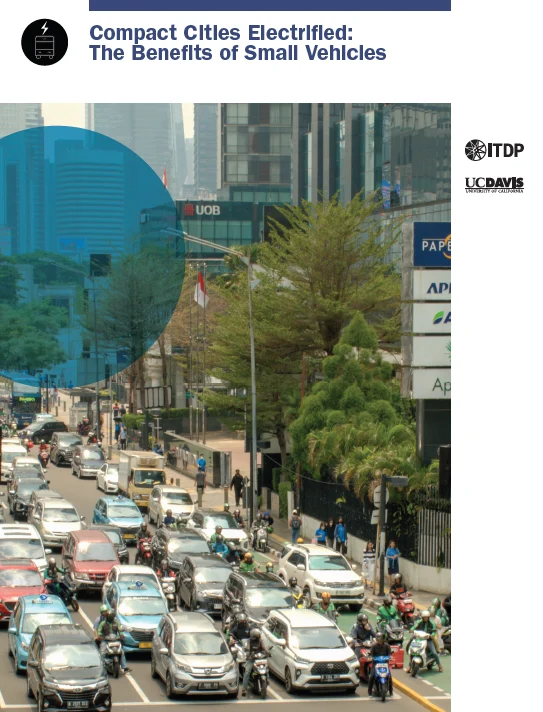
Cover of the New ITDP and UC Davis Report

Infographic of the Benefits of Smaller Vehicle Sizes
ITDP Logo
Combined action on vehicle size, rapid electrification, and increased public transport, walking, and cycling is crucial to the future of urban areas.
The report, Compact Cities Electrified: The Benefits of Small Vehicles, analyses passenger transport trends in six major economies: Brazil, China, India, Indonesia, Mexico, and the United States. The research evaluated five potential scenarios: a continuation of current trends in vehicle size growth and fleet electrification; a focus on maintaining vehicle size at 2020 levels; a shift towards more walking, cycling, and public transport for urban areas; more rapid vehicle electrification; and a combination of all three changes.
The report shows that policies to address increasing vehicle size deliver benefits across multiple areas, including lower consumer costs, reduced fuel and electricity demand, fewer traffic deaths, and meaningful reductions in greenhouse gas (GHG) emissions.
Combined action
The combined strategy delivers the greatest benefits, dramatically reducing emissions, pollution, and transport costs. Under this integrated scenario, urban passenger transport emissions across the six countries could fall by more than two-thirds. This would save around 1.2 gigatons of CO₂-equivalent each year by 2050 — roughly equal to Indonesia’s total emissions in 2023.
Electric shift
Smaller vehicles and reduced car use can significantly ease the infrastructure demands of electrification. In scenarios combining electrification with smaller vehicles and mode shift, overall energy consumption could drop by 70% and liquid fuel demand by 85%, while keeping battery requirements close to current trajectories.
Vehicle size limits
Capping vehicle size alone could reduce private-sector direct costs by a fifth (19%-22%), with reductions for consumers, including lower costs for vehicle purchase, maintenance, and fuel by 2050. The analysis also found significant reductions in: liquid fuel demand by up to 14%; electricity consumption by up to 12%; battery requirements up to 14%; road crash deaths up to 9 % and reductions in GHG between 4% - 10%.
Mode shift
Mode shift policies alone could also save up to 1.5 million lives globally by 2050 through increased physical activity from walking and cycling, while also reducing road traffic deaths—currently the leading cause of death for people under 30.
The study concludes that governments and cities have multiple pathways to improve urban transport systems, but the greatest benefits come from implementing integrated and systemic policies that simultaneously promote public transport and active mobility, accelerate vehicle electrification, and limit the growth of vehicle size.
Rapid electrification would also be easier and more affordable by reducing the materials, infrastructure, and investment required when combined with size limits and modal shifts. Without policy intervention, however, the study warns that the current trajectory—marked by rising car use and larger vehicles—could lock cities into a future of higher costs, greater pollution, and increased road fatalities.
“The choice of urban transport future ultimately rests with national and local governments,” the report notes. “Strategic policies today can shape cities that are safer, more affordable, and far less polluting. These findings show that vehicle size is not just a design choice—it has major implications for energy use, affordability, safety, and climate outcomes,” said Heather Thompson, ITDP CEO. “Policies that prevent vehicles from getting larger can deliver substantial benefits, especially when combined with other transport strategies. This is especially important these days as we see the availability and price of fuel increasing significantly.”
Sheila Watson, Deputy Director of the FIA Foundation, said: “We are currently experiencing a global energy security crisis. People around the world are seeing their costs at the pump and elsewhere rising by the day because of their reliance on fossil fuels. This report shows how the right combination of policies, to accelerate electrification, cap vehicle size, and shift urban transport modes, reduces that reliance and saves consumer costs all whilst significantly pushing the dial on climate action.”
Notes to editors:
Jacob Mason, ITDP Senior Director of Global Programme, is available for further comment and interview. For further information and interview requests, please contact Kate Turner, Media Manager of the FIA Foundation, on k.turner@fiafoundation.org +44 7879893222. The study is set against the backdrop of significant concerns about the rising size and popularity of sport-utility vehicles (SUVs). Global SUV sales increased from about 20% of vehicle sales in 2008 to more than 50% in 2022. Larger vehicles are heavier and require more energy to move, raising costs for essential journeys as oil costs rise globally.
###
About the FIA Foundation
The FIA Foundation is an independent UK registered charity which supports an international program of activities promoting safe roads, clean air and climate action.
www.fiafoundation.org
About the Institute for Transportation and Development Policy
The Institute for Transportation and Development Policy (ITDP) is a global nonprofit organization that works with cities to design and implement high-quality transport systems that reduce emissions, improve safety, and enhance quality of life.
www.itdp.org
About the University of California, Davis
University of California, Davis is a leading public research university whose transportation research programs focus on sustainable mobility, energy systems, and climate solutions.
www.its.ucdavis.edu
Veronica Ortiz
Institute for Transportation and Development Policy
veronica.ortiz@itdp.org
Visit us on social media:
LinkedIn
Bluesky
Instagram
Facebook
YouTube
X
Other
Legal Disclaimer:
EIN Presswire provides this news content "as is" without warranty of any kind. We do not accept any responsibility or liability for the accuracy, content, images, videos, licenses, completeness, legality, or reliability of the information contained in this article. If you have any complaints or copyright issues related to this article, kindly contact the author above.
